Start with
what you have.
Measured values for a law, or prompt/output pairs for a text experiment. Inspect and edit your examples before fitting.
An independent laboratory for symbolic intelligence
A pattern is only the beginning.
Find its equation. Inspect its logic. Make it yours.
Open in your browser. No account. No inference API key.
 The1 / study no. 001
Runs on your device
Equations you can read. Experiments you can own.
By Racore / 2026The1 is a symbolic discovery engine: it searches candidate mathematical relationships and tests them against observations. The result is a relationship you can inspect, question, and evaluate.
E = ½mv2
To a relationship you can interrogateBring a table, prose measurements, or a formula. Choose the target, discover a candidate law, and explore its inputs, constants, fit, and residuals.
Open law discovery ↗Prompt “What is a seed?”
Output “A seed makes an experiment reproducible.”
A small word-polynomial experiment. Edit the starter examples, set a seed, discover the equations, and test your own chatbot in an internal playground.
Build a text experiment ↗Experimental text model. Not a pretrained general-purpose LLM.The useful part is the path between input and output. Keep the observations, encoding, equation, and evaluation together.
Measured values for a law, or prompt/output pairs for a text experiment. Inspect and edit your examples before fitting.
Turn the data into numeric features. In the text lab, each known Unicode word gets independent frequency and position signals.
Compare candidate laws against held-out observations. A fixed seed keeps the experiment reproducible.
Move a control or send a message. Read the equation and its evaluation. Improve the examples when a relationship fails.
Create Your LLM IN 1 Minute
No training server to set up. No black box to borrow. Just an editable curriculum and a small model you can take apart.
Create my text model ↗One minute to set up. Download and fitting time depend on your connection, examples, and device.
144 editable The1-guide examples or a 72-example science tutor. Add your own prompt/output pairs or import a JSON project.
Unicode IDs become separate frequency and position features. The1 compares polynomial degrees and regularization on held-out prompts.
sₖ(w) = bₖ + ΣⱼΣᵣ αₖⱼᵣ wⱼʳ + βₖⱼᵣ pⱼʳTry response selection for readable answers, or experimental word equations for direct token prediction. See the metrics and export the full model.
This does not create a foundation model. The response decoder selects a supplied output; the word decoder can produce unrelated word sequences. The limitations are part of the experiment.
Parsing, fitting, and replies run in your browser. Your observations are not uploaded for inference.
A good fit is evidence about the tested examples. Held-out metrics help; they do not guarantee a unique law or general understanding.
Sessions and text projects stay in localStorage on this browser. Export a backup before clearing site data or changing devices.
Inspect the coefficients, test a new input, or change the examples. A model should give you something concrete to challenge.
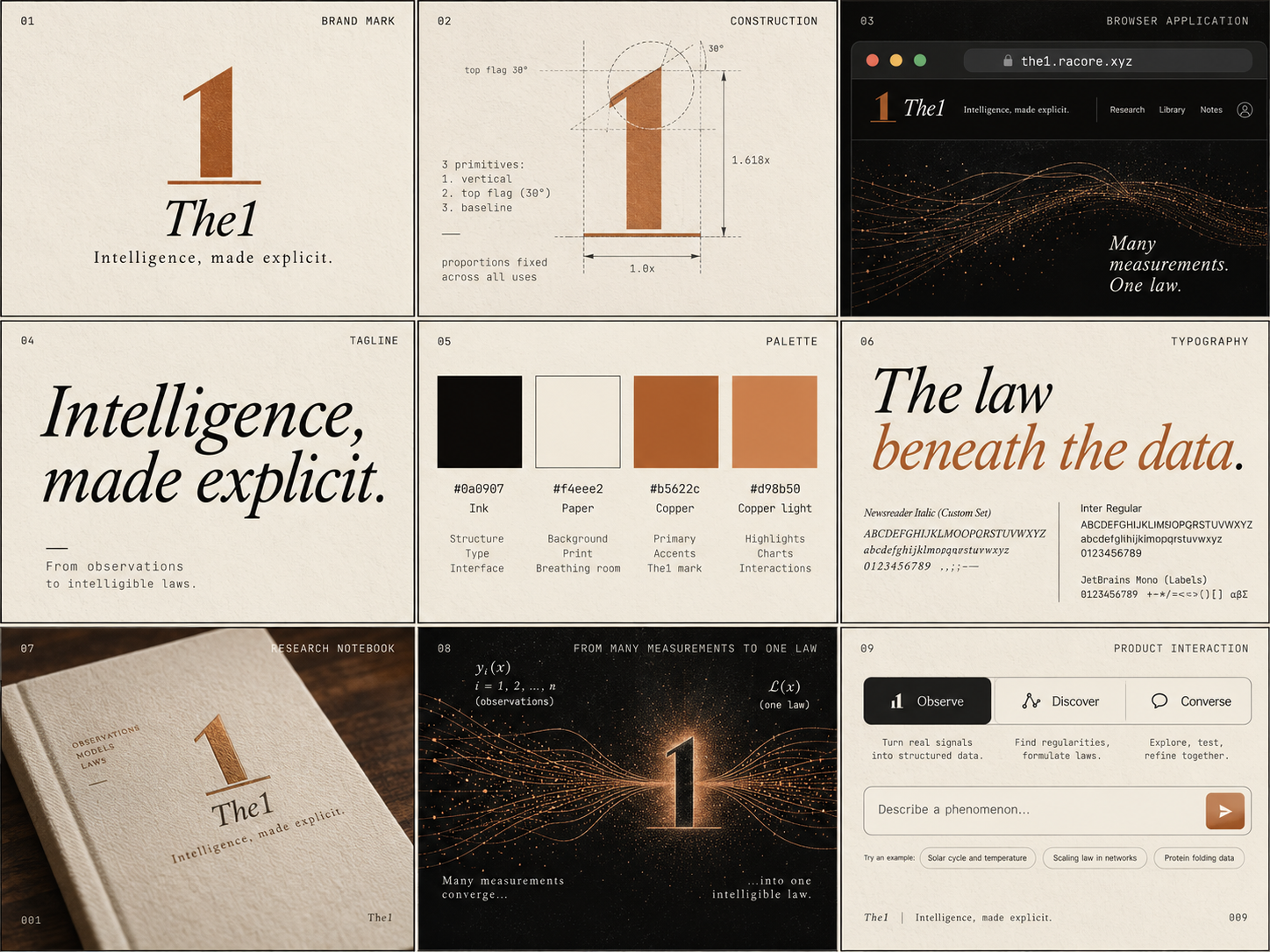
The singular numeral stands for the relationship beneath many observations. Warm paper keeps the work human; copper draws the signal out of the dark.
No. The1 is a symbolic discovery engine. The text lab adds a small polynomial model over word features. It has a finite response library and an experimental fixed-position word decoder; neither provides the breadth of a pretrained LLM.
The starter dataset and controls make setup quick. Runtime downloads, fitting, and evaluation take different amounts of time on different devices. There is no promise of a complete training run in 60 seconds.
The site downloads engine files from Hugging Face and browser runtime packages from public CDNs. Your examples, messages, and learned coefficients are processed on your device, without a hosted inference service.
Yes. The text lab uses Unicode words and accepts Arabic and English in the same dataset. Normalization and word statistics are visible in the model inspector. This does not imply semantic understanding of either language.
They are saved in localStorage for this browser and domain. Clearing storage removes them. Use Export project to keep your examples, tokenizer, equations, coefficients, settings, and conversation in a portable JSON file.
A fresh visit downloads the engine and needs an internet connection. Once the engine is loaded, fitting and inference happen locally. Model assets are intentionally fetched again on each new page load.
The next observation is yours.